
Knap of Howar: Exploring the UK’s Oldest Surviving Home
When people think of ancient Britain, landmarks like Stonehenge often come to mind. However, the oldest surviving building in the UK is far older — and far less known. Hidden on a remote Scottish island lies Knap of Howar, a remarkably preserved stone house that dates back more than 5,000 years.
This extraordinary structure gives us a rare glimpse into prehistoric life in Britain and stands as one of Northern Europe’s oldest surviving homes.
Knap of Howar, located on the island of Papa Westray in Orkney, Scotland, is widely recognized as the oldest surviving building in the UK, dating back to around 3700 BCE and standing for more than 5,000 years, and today the site continues to attract historians, archaeologists, and building professionals who carefully survey its structure to understand how it has endured for millennia. This remarkable Neolithic stone house predates Stonehenge and the Egyptian pyramids, and every modern survey carried out at the site reveals new insights into early construction techniques, settlement patterns, and the origins of domestic architecture in Britain. Unlike ceremonial monuments, Knap of Howar was a lived-in home, and through detailed archaeological survey work, researchers have reconstructed how early farming families organized their daily lives within its thick stone walls. The first recorded scientific survey of the site in the twentieth century confirmed that the building consisted of two connected rectangular structures, and since then each additional survey has refined measurements, materials analysis, and spatial understanding. A structural survey of the walls shows that locally sourced flagstone was carefully layered without mortar, while a condition survey demonstrates how the building’s design protected it from Atlantic winds. Through repeated survey documentation, experts have mapped the layout, identifying stone beds, storage shelves, and a central hearth, and each interior survey helps confirm that this was a permanent settlement rather than a temporary shelter. The importance of survey methodology at Knap of Howar cannot be overstated, as a measured survey provides precise dimensions that allow historians to compare it with other Neolithic sites such as Skara Brae. Modern digital survey tools, including laser survey scanning and photogrammetry survey techniques, have created accurate 3D models of the structure, ensuring that even if erosion occurs, a full architectural survey record will remain. An archaeological survey of artefacts discovered pottery fragments, animal bones, and stone tools, and every excavation survey layer contributed to a clearer timeline of occupation. Environmental survey studies of soil and surrounding land indicate that early residents practised organised farming, while a landscape survey of the coastline explains the strategic choice of location. Preservation experts regularly conduct a conservation survey to monitor stone stability, and a heritage survey ensures the site remains protected under Scottish historical regulations. Each new survey builds upon previous survey findings, creating a comprehensive survey archive that strengthens our understanding of prehistoric Britain. From a construction perspective, a building survey reveals that the walls were unusually thick for insulation, while a material survey confirms the durability of Orkney flagstone. Through detailed survey comparison with other ancient dwellings, researchers conclude that Knap of Howar represents one of the earliest examples of planned domestic architecture in Northern Europe. A structural integrity survey demonstrates how the interlocking stones distribute weight evenly, and a weather impact survey explains how centuries of sand coverage shielded the house from severe erosion. Educational institutions often reference the site in academic survey reports to teach students about early engineering principles. Tourism authorities also rely on visitor survey feedback to improve access while maintaining preservation standards. The consistency of survey research over decades highlights the building’s resilience, and each updated survey refines historical interpretation. Even a simple visual survey by visitors reveals the remarkable preservation of interior features, while a professional measured survey ensures that architectural drawings remain accurate for study and publication. Heritage organisations conduct periodic risk survey assessments to evaluate environmental threats, and a management survey outlines strategies for long-term conservation. Through cumulative survey evidence, historians now understand that the farmstead was occupied for nearly 900 years, making it not only the oldest building in the UK but also one of the longest continuously used early homes ever documented. The discipline of survey science has therefore played a central role in uncovering the story of Knap of Howar, transforming it from a buried ruin into one of Britain’s most significant prehistoric landmarks. Every survey, whether archaeological, structural, environmental, or digital, adds another layer of understanding, proving that careful survey practice is essential when studying ancient architecture. Today, thanks to centuries of natural preservation and decades of professional survey work, Knap of Howar stands not merely as an isolated relic of the past but as a fully documented example of early settlement, its stones measured, recorded, analysed, and preserved through meticulous survey efforts that continue to protect its legacy for future generations.
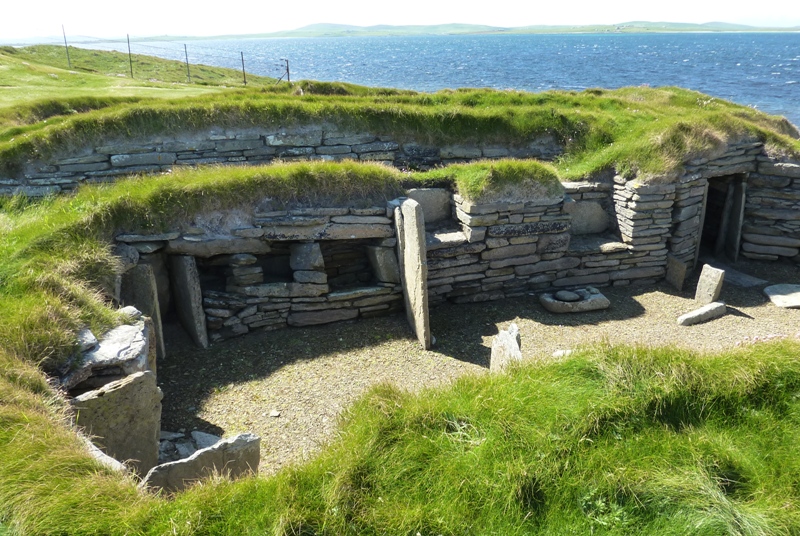
Photo by Otter, licensed under CC BY-SA 3.0.
Source: https://commons.wikimedia.org/wiki/File:Knap_of_Howar_20110530_house_2_from_north.jpg